
178 Global Organisations Exposed to a Cyberattack: Why Digital Trust Is Now a Strategic Priority for the Financial Sector
18 nov 2026
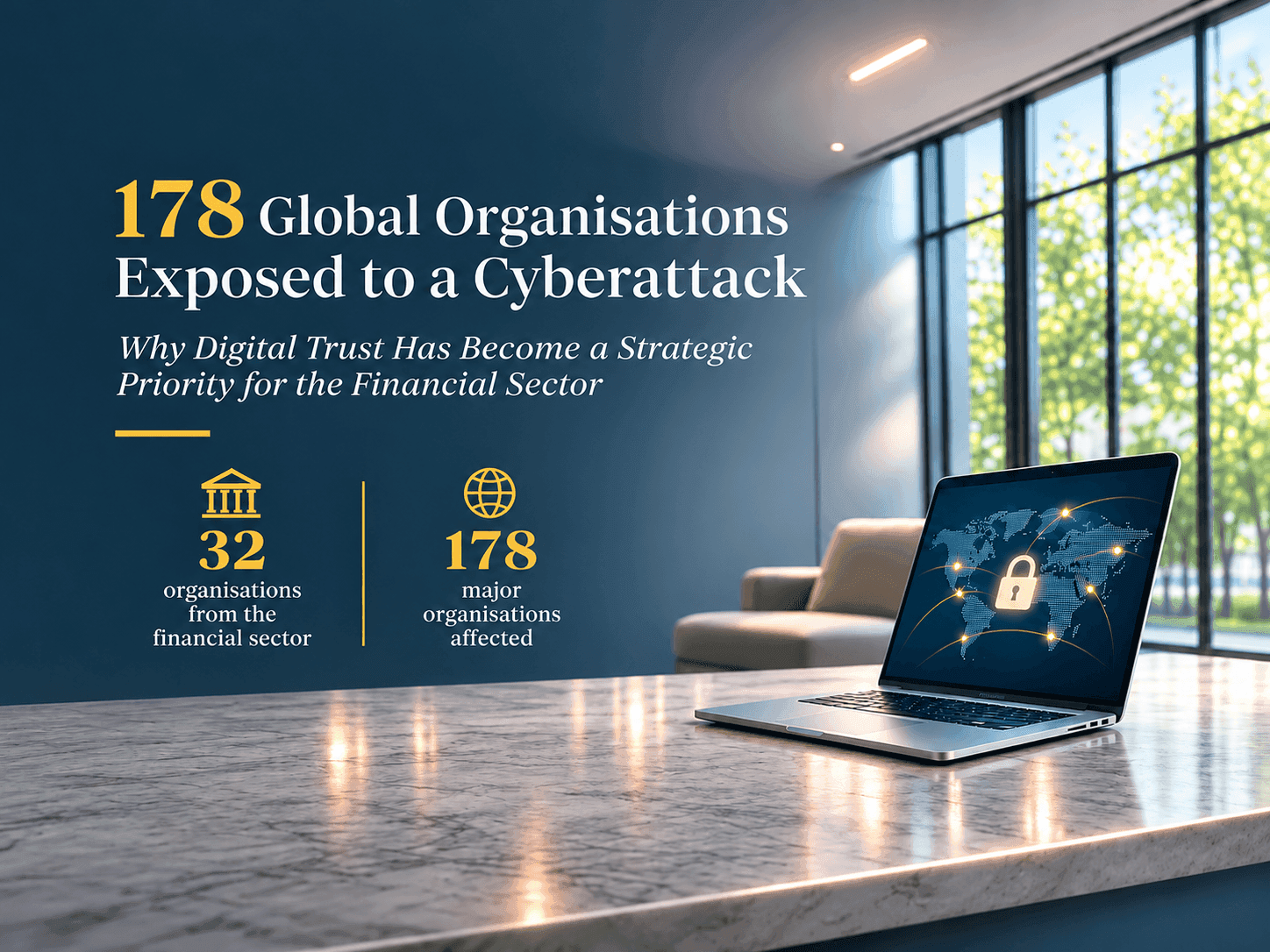
178 Global Organisations Exposed to a Cyberattack: Why Digital Trust Has Become a Strategic Priority for the Financial Sector
A recent cybersecurity incident involving the Optimizely platform has highlighted one of the main risks facing major organisations today: growing dependence on external technologies and digital supply chains.
According to research published by Report URI, malicious JavaScript code was distributed through Optimizely projects associated with 178 organisations worldwide, including companies and institutions such as HSBC, Salesforce, BBC, CNN, Ledger, Equifax, IKEA and Air France-KLM.
The incident affected sectors including banking, financial services, technology, media, aviation and retail. The financial sector was particularly exposed, with 32 organisations identified.
The malicious code reportedly included mechanisms designed to capture payment information, manipulate cryptocurrency transactions and exploit vulnerabilities in certain devices.
The incident raises an important question for the financial industry: how secure can an institution truly be when part of its operational resilience depends on an increasingly complex network of external technology providers?
Digital Supply Chains: A Growing Risk
Modern organisations depend on cloud services, APIs, software platforms, applications and third-party technology providers to operate efficiently.
These technologies expand capabilities, but they also increase the potential attack surface.
For this reason, cybersecurity can no longer focus exclusively on protecting an organisation’s internal infrastructure. Security increasingly depends on the strength of the entire digital ecosystem surrounding it.
This is particularly relevant in financial services, where operational continuity, data protection and institutional trust are fundamental.
Cybersecurity has therefore evolved from being primarily an IT responsibility into a strategic issue for boards, executive teams and investors.
The objective is no longer simply to prevent unauthorised access. Organisations must also be capable of maintaining their critical operations when part of their technology ecosystem is compromised.
DORA and Financial Operational Resilience
In Europe, this challenge has become even more relevant with the Digital Operational Resilience Act, or DORA, which has applied since 17 January 2025.
DORA establishes a common framework designed to strengthen the ability of financial institutions to withstand, respond to and recover from technological disruptions.
Its scope extends beyond traditional cybersecurity and includes ICT risk management, incident reporting, operational resilience testing, third-party technology risk and information sharing.
Incidents involving third-party platforms such as Optimizely demonstrate why this approach is becoming increasingly important.
Financial institutions must not only protect their own systems, but also understand, assess and manage the risks associated with the technology providers on which their operations depend.
Cybersecurity, operational continuity, technology risk and regulatory compliance are therefore becoming part of the same strategic framework.
AdamantWare Within the ALCRAL Ecosystem
This environment is particularly relevant for ALCRAL.
As a Group operating within the financial and business sectors, we understand the importance of technological security, institutional confidence and operational continuity.
The Group also participates in AdamantWare, a company specialising in cybersecurity, software development, advanced technology and authentication solutions.
AdamantWare works on strengthening digital environments, protecting critical systems and developing technological solutions designed to respond to an increasingly sophisticated threat landscape.
Its work is especially relevant within the financial sector, where technological and regulatory requirements continue to increase.
Beyond cybersecurity protection, AdamantWare also contributes to helping organisations assess and strengthen their operational resilience and their alignment with regulatory frameworks such as DORA.
The combination of cybersecurity, software development, advanced authentication and an understanding of financial-sector requirements represents an increasingly important area for the Group.
Technology Security and Compliance Are Converging
The distinction between cybersecurity and regulatory compliance is becoming increasingly difficult to maintain.
Protecting a financial institution means protecting its technology, maintaining operational continuity, managing third-party providers, responding effectively to incidents and demonstrating that appropriate resilience mechanisms are in place.
DORA reflects this shift.
AdamantWare is developing in the same direction, combining technology, cybersecurity, authentication and operational resilience within a comprehensive approach.
For ALCRAL, this represents more than a business opportunity. It means participating in one of the most important strategic challenges currently facing the financial industry.
The Future of Finance Will Be Built on Digital Trust
The digital transformation of financial services will continue to accelerate.
Artificial intelligence, automation, cloud services and increasingly interconnected technology platforms will create significant opportunities, but also new dependencies and risks.
As technology evolves, the systems designed to protect it must evolve as well.
The next generation of financial infrastructure will increasingly depend on three fundamental principles:
Security. Resilience. Trust.
The Optimizely incident once again demonstrates that cybersecurity can no longer be treated as a secondary issue.
The future of financial services will not simply be built on more technology.
It will be built on secure, resilient technology that clients, institutions and markets can trust.